Merging remote and in-person learning with Kubi Robots.
Role Summary
Applied research into challenges and opportunities for telepresence in the LDT program. Evaluated various telepresence solutions before choosing to pilot the Kubi robots. Guided faculty and staff to integrate robots into the flow of classes, and then evaluated and made recommendations on further use.
Development Summary
- Client: Faculty members for the “Learning, Design, & Technology” program at Georgetown University.
- Deliverable: Pilot and Analysis evaluating the use of telepresence robots in the classroom.
- Tools Used: Zoom, “Kubi” robot, Google Apps.
- Duration of Pilot and Analysis: Research, implementation, and analysis took place in iterative cycles over the course of two semesters, or approximately eight months.
Background
The Learning, Design, & Technology program at Georgetown University facilitates classes that accommodate a mix of in-person and remote learners during the same class sessions. On any given day, there are a mix of students either in the classroom, or else attending remotely via web-conference.
The flow of communication and collaboration between these two populations needed improvement, and we needed a solution that would give remote learners added agency and presence. Based on the results of a mixed methods study (surveys, interview, and focus group) conducted in the fall semester of 2018 by myself and one of our students (Camron Robinson), we decided to propose experimentation with telepresence robots as a way to rethink what it means for remote participants to be present in the room and engaging with others.
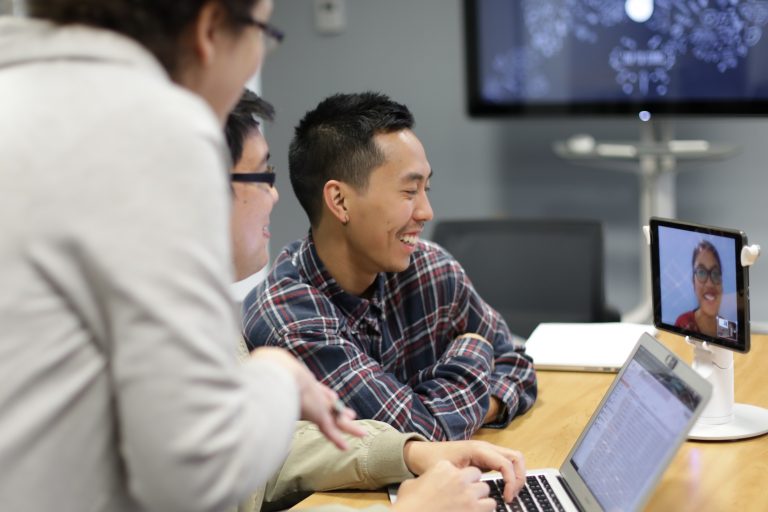
(Photo Credit: Yiran Sun)
Process
Applied Research and Recommendations
Many respondents from the initial study (students and faculty) speculated about the possibility of multiple smaller displays representing remote individuals as opposed to one larger one consolidating them all. In these cases, some knew about telepresence robots while many others were speculating imaginatively at the concept. The commonality was a desire to make audio-visual interaction more intimate, more individual, less formal, and more at each other’s level.
We decided to experiment with telepresence robots to better facilitate flow, and to avoid some of the challenges for collaboration posed by one large display. As part of our initial foray, we did some “desk research” comparing several models, evaluating not only their differences in price and quality, but also looked at usability and software considerations for our classroom environment. We ultimately decided to recommend experimenting with the Kubi, one of the two models that were able to be used with our existing cache of ipads. This was an important means to mitigate cost and complexity, where we envisioned experimenting with the flow of using these devices in the classroom as a proof of concept, while also giving ourselves some leeway to continue using Zoom as our web conferencing utility.
Presentation slide deck from the initial study outlining insights derived from student experiences in the hybrid classroom, and recommending the use of telepresence robots as a means of facilitating enhanced collaboration between the in-person and remote learners.
Proposal making the case to look more deeply into either the Kubi telepresence robots, or else a mobile version from Double Robotics
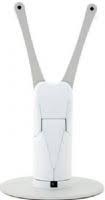
The Kubi Robot. (Source: kubiconnect.com)
Prototyping
Having purchased a few models of the Kubi, I first started with becoming intimately familiar with how it worked. The affordances and constraints, as well as potential opportunities and challenges that would line up well with any of our faculty in particular. The class we ultimately chose for our pilot was the “Methods of Learning and Design”, a class that regularly rotated between classwide discussion and breakout groups in the classroom to engage in design related activities. Additionally, the faculty for this class were enthused and eager to try an approach that would improve their ability to help their remote learners to feel like a better integrated part of the class.
The robot itself is a stationary robot that can be remotely controlled by remote users. An ipad is placed within the two “arms”, after which students can use the robot to control movement and perspective, and the Zoom app on the ipad to participate in the zoom session connecting in person and remote participants. While the robot was not mobile (couldn’t be driven around) like the other robots we had considered, this device could easily be moved by students in the room when needed.
Training and familiarization was an important first step in the pilot. It was important for the faculty, the teacher’s assistant, and all of the students to be familiar with the tool in order to avoid confusion, and to help it feel like a more natural aspect of collaboration within the class. Together with the TA (Alexandra Chugunova) and faculty member, we closely monitored how students were responding in class, then followed up with a survey to get a feel for how it was working out.
Outcomes & Lessons Learned
Presentation slide deck outlining insights derived from student experiences in the hybrid classroom, and recommending the use of telepresence robots as a means of facilitating enhanced collaboration between the in-person and remote learners.
Evaluation and Feedback
The majority of students responded to the survey, 100% of which indicated that they would want to continue using the robots in this particular class.
The general consensus was that these devices made the in-person students more considerate and mindful of remote learners, and made it easier for them to manage breakout rooms than it had been previously with the larger room system. Previously, students were leaving the room with laptops any time they were asked to spread remote students across breakout groups. For remote learners, the devices gave them a much preferred perspective at eye level with other students, as compared to the birds-eye view inherent to a camera meant to capture the whole room. They also gave remote learners the agency to look around, something they didn’t know they wanted before trying this out.
The limitations were also noticeable however. Whereas kubi had previously supported native zoom integration that allowed for controlling the robot, the integration was no longer available forcing students with only one monitor to balance a zoom window next to an X/Y axis for controlling the robot. Also, whenever remote students outnumbered the number of devices in the room, they were forced to share the same device leading to some confusion for students in the room.
Ultimately, these devices have gained regular use for classes that have involved a teaching style incorporating heavy use of breaking the class up into smaller groups for discussions with a mix of in person and remote learners. They are avoided for classes with more of a focus on class-wide discussion or projects centered in digital environments where laptops are a better fit.
